

Concrete Slab Installation Services in Montgomery County, TX | We Prep & Pour Shop Floors, Barn Slabs and Equipment Pads
Shop and barn owners across the county hire Montgomery County Concrete Contractors when the slab has to carry real weight. As a Montgomery County concrete slab contractor, we've poured everything from generator pads in The Woodlands to shop floors on Magnolia and Cut and Shoot acreage. Our family has built in Texas since 1985 and has completed more than 500 projects.
We pour shop and garage floors, barn slabs, metal-building pads, generator and equipment pads, and oversized residential slabs. Every slab gets 3,000-plus PSI concrete, a steel rebar grid and a heavily compacted base. We add thickened edges wherever trucks, RVs or equipment sit near the edge. Our quotes are free, written and held for three months.
- Free on-site estimates
- Fully insured
- 3,000+ PSI with rebar
- Owner on every job
- Since 1985Family building in Texas
- 500+Projects completed
- 5.0Rating on Google
- 3 monthsWritten quotes honored
Concrete Slab Contractors in Montgomery County, TX Plan for the Load First
Our first question on every slab quote is what will sit on it and where. Two-post car lifts, loaded trailer tongues and skid steers create point loads far heavier than a parked car. Instead of making the whole slab thicker than it needs to be, we design thickened edges, a heavily compacted sub-base and extra steel where the weight concentrates.
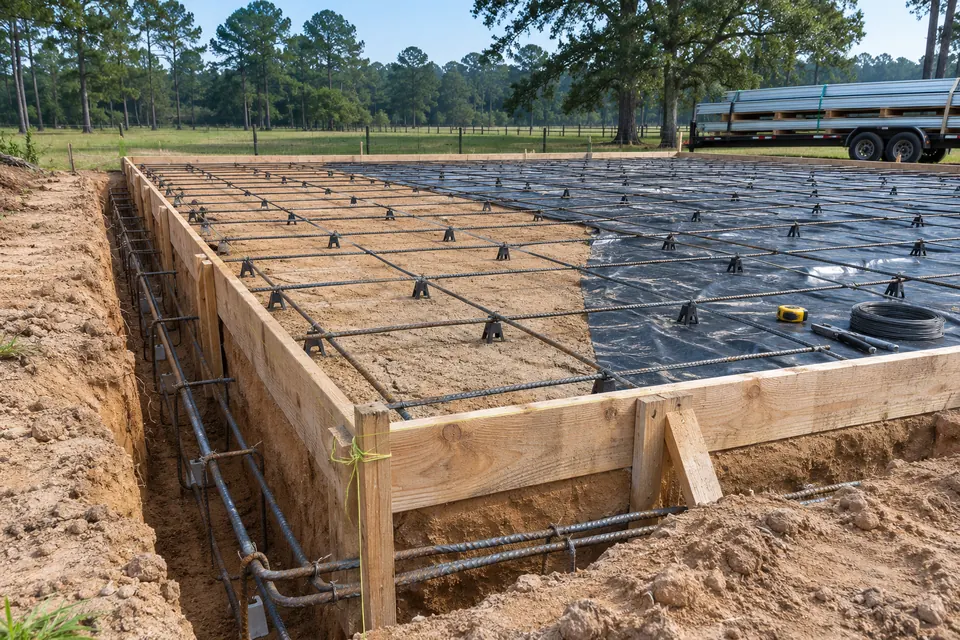
Workshop and Garage Slabs in Montgomery County, TX
We pour detached garage and workshop slabs sized to the building, with anchor bolts or embeds set where your framer or steel erector needs them. Our crew coordinates the layout with whoever is putting up the building, and we can grind and polish the floor afterward for a cleaner shop surface.
Every garage floor we pour falls gently toward the door so water drains out instead of puddling under the car. Tell us at the estimate if you plan a floor drain or a car lift. We change the steel layout before we pour, and sometimes the thickness under the lift posts too.
Barn and Shop Floors for Metal Buildings
Our barn and metal-building floors are a big share of our acreage work around Magnolia, Todd Mission and Cut and Shoot. We pour the floor and the perimeter grade beams the building supplier's drawings call for and set anchor bolts to the column layout. Inside, we trowel the floor smooth, and outside the overhead doors, we broom the aprons for traction.
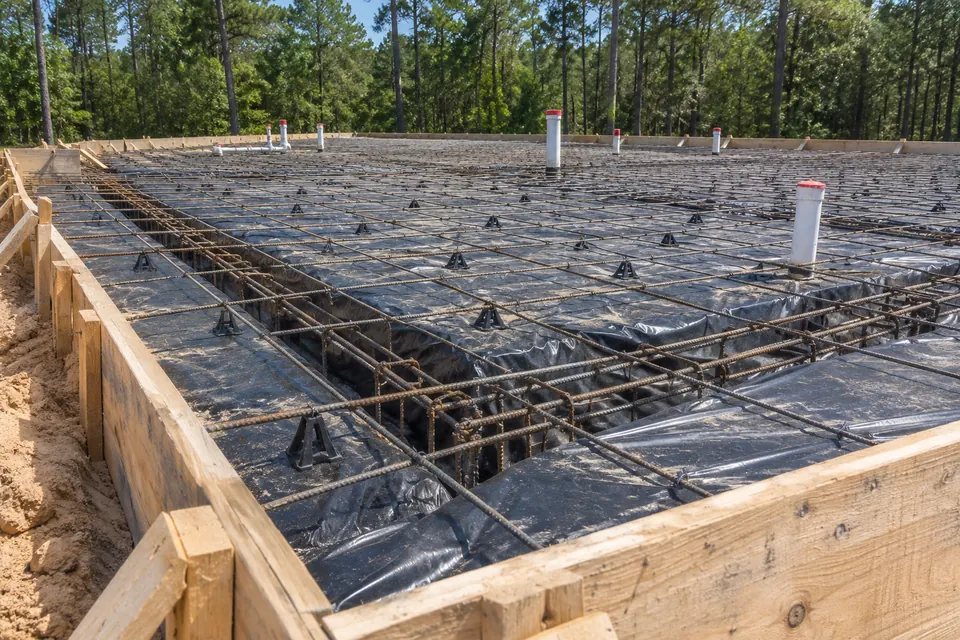
Shed and Storage-Building Pads
We pour shed and storage-building pads a little larger than the building's footprint so the doors open onto concrete, and we slope each pad just enough to drain. Most shed pads take us a single pour day once the base is ready, and we can have the pad cured before your building is delivered.
Equipment and Generator Pads
We pour standby generator pads, pool-equipment pads, propane-tank pads and machinery slabs, each reinforced and sized to the weight. Our licensed electricians and plumbers can handle the generator's transfer switch and gas line on the same job, and in The Woodlands we place the pad where the design standards allow.
AC Condenser Pads
Our crews replace settled, tilted and cracked condenser pads with poured concrete sized to the unit and set level on a compacted base. A level pad keeps strain off the refrigerant lines and keeps the unit out of standing water, and your HVAC technician handles the disconnect and reconnect.
Oversized Residential Slabs
We pour oversized residential slabs for sport courts, combined parking and work areas, and large additions. On these, our crews pour in planned sections with doweled construction joints, so each section ties to the next and the finished slab behaves as one piece.
Finishes for Working Floors
Our crew matches the finish to how each area works. Inside a shop or garage, we steel-trowel the surface so it sweeps easily and a creeper rolls smoothly. Outside the doors, we broom the aprons so they grip in the rain. We also grind and polish interiors for a showroom look and leave barn floors where animals stand with a coarser texture. We settle the finish for each area before the pour, because it can't be changed once the concrete sets.
How We Build Slabs for Montgomery County Clay
We build every slab for clay that can swell and shrink by as much as 30% between dry and saturated conditions. For building slabs we follow the approach behind Building Research Advisory Board Report #33, which recommends Type III foundations that act like a rigid raft and assume the ground will move. Only about half of residential foundations in the county are professionally engineered, so we tell you when we think yours should be.
Whenever there's a geotechnical report and an engineer's design, we build to it exactly. Our crews over-excavate high-expansion native clay and replace it with select fill when the report calls for it, and we use lime stabilization of the subgrade on clay-rich wooded lots. Those steps are listed separately on your quote so you can see what the ground adds.
Slab Work in Different Parts of the County
Magnolia and Todd Mission
Shop floors, barn slabs and barndominium porches on unrestricted acreage make up most of our slab work out here.
Cut and Shoot and Splendora
We pour RV pads with thickened edges, carport slabs and shed pads on rural lots.
The Woodlands and Shenandoah
Our slab work here is mostly generator pads, AC pads and garage additions that pass design review.
Conroe and Willis
We pour detached garage and workshop slabs on older in-town lots and newer subdivisions alike.
When We Bring in an Engineer
For large shop floors and slabs carrying unusual loads, we bring in a licensed structural engineer when the design calls for one and build to the stamped plans exactly. That coordination is part of our scope, so you don't have to manage the engineer and the concrete crew separately.
Slab Options and Add-Ons We Build In
We build these options into a slab before the pour, because adding them later means cutting or coring finished concrete:
Thickened edges
We dig a deeper perimeter trench with continuous rebar so walls, overhead doors and parked trucks sit on extra concrete.
Anchor bolts and embeds
Our crew sets bolts and embeds to your building's column layout on templates, checked before the truck arrives.
Floor drains and trench drains
We set drains and pitch the floor toward them in wash bays, shops and barns.
Plumbing and electrical sleeves
Our licensed plumbers and electricians set sleeves and stub-ups in the forms for sinks, outlets and equipment.
Vapor barrier
We lay a plastic vapor barrier under interior slabs so ground moisture doesn't come up through the floor.
Insulated or heated floors
We coordinate with your HVAC or radiant-floor installer so tubing or insulation goes in on schedule, before the steel and the pour.
Polished or sealed finish
Our crews grind and polish shop and showroom floors or seal them so oil and stains wipe up.
What to Have Ready Before We Quote a Slab
A sketch is enough for us to price a slab, but these details make your quote faster and more accurate:
- The building's footprint and the supplier's anchor bolt or column drawings, if you have them
- What will sit on the slab: lifts, trailers, RVs, tractors or heavy equipment, with weights where you know them
- Where doors, drains, sinks and outlets go
- Any engineer's design or soil report for the site
- Whether the slab is on a county road with a ditch, so we can plan truck access and any culvert
Our owner walks the site with you and checks the ground, the slope and how a loaded ready-mix truck will reach the forms. Then he writes a firm price with thickness, steel and finish spelled out for each area of the slab. That price holds for three months, which gives you time to order the building.
How Long a Slab Takes Us
We usually need one to two days of prep for a shed or equipment pad, and more for a large shop floor with edges, embeds and sleeves. Pouring and finishing then takes one to two days. You can walk on new concrete after about a day and drive light vehicles on it after about a week. We give you a date for heavier loads, lifts and building delivery based on your slab. Every slab we pour carries our one-year workmanship warranty, and we photograph the steel, embeds and sleeves before the pour so you have a record of what's inside the concrete. For larger building slabs, we take a deposit and progress draws tied to milestones instead of full payment up front.
Where the Money Goes on a Slab
Our slab prices depend on the footprint, thickness, edges, steel and base. A plain shed pad and a lift-ready shop floor can cost very different amounts per square foot, so we price after seeing the site and the building plans. Your quote is free and written with no hidden fees, and it holds for three months.
- Thickened edges and extra steel for heavy point loads
- Over-excavation, select fill or lime stabilization when the soil calls for it
- Anchor bolts and embeds set to the building drawings
- Interior trowel or polished finish versus broom-finish aprons
- Access for the ready-mix truck on wooded or soft acreage
Bigger slabs run on a deposit and progress draws, and we get your written approval before any change to scope. Our military, veteran, senior, first-responder and teacher discounts apply to slabs too.
How We Pour a Shop or Barn Floor
Site and plans
We walk the pad site and review the building supplier's or engineer's drawings.
Pad, forms and steel
Soft clay comes out, and we bring in and compact select fill or stabilize as specified. Then we set forms, dig grade beams, tie rebar and place anchor bolts to the column layout.
Pour and finish
Our crew places and finishes the slab, trowels the interior and brooms the aprons.
Cure and hand-off
We strip forms, clean up and hand the pad over ready for the building.
Concrete Slab Questions
How much does a shop or barn slab cost in Montgomery County, TX?
Slab size and thickness set the base price. Thickened edges, grade beams, anchor bolts, sleeves and site prep add to it, and a pump adds cost when the truck can't reach the forms. We spell out each line in a written quote held for three months.
Who is the best company for a concrete slab in Montgomery County?
We'd look for a contractor who asks what will sit on the slab before quoting it. We plan thickened edges and steel around your loads, build to the engineer's design when there is one, pour 3,000-plus PSI concrete, and stand behind it with a one-year workmanship warranty.
Do I need an engineer for my shop slab?
For many metal buildings the supplier's drawings include the foundation design, and we build to them. For larger buildings or difficult soil we'll recommend a geotechnical report and an engineer before we pour.
Can you pour a pad for my standby generator?
Yes. We pour reinforced generator pads sized to the unit and placed where the installer needs them, and in The Woodlands we place them to suit the township's standards.
Will you set anchor bolts for my metal building?
We set anchor bolts and embeds to the column layout on the building drawings, and we check the layout with your erector before the pour.
How thick should an RV pad be?
Our RV pads go thicker than the standard 4-inch driveway, with thickened turn-down edges and a heavily compacted sub-base. We size it to the vehicle you'll park on it.
Can you pour the slab for a barndominium with living quarters?
Yes. A barndominium with living space is a house as well as a shop, so we pour it to the engineered foundation design. Licensed master plumbers set the plumbing rough-ins before the concrete goes down.
Can you replace my sunken AC pad?
We can. We pour a new level concrete pad on a compacted base, and your HVAC technician handles disconnecting and reconnecting the unit.
Send Us the Building Plans
Call or use the form and attach what you know: footprint, building type and what will park inside. We'll visit the site and write a firm slab price.